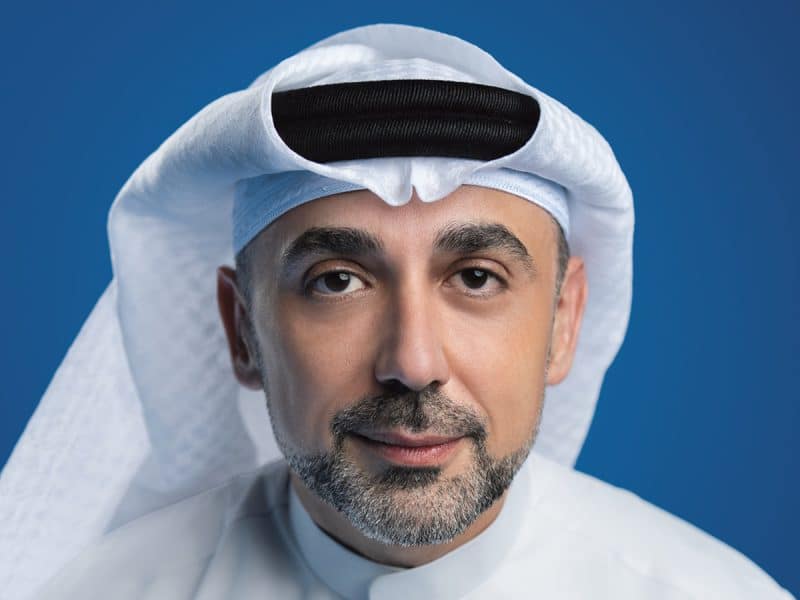

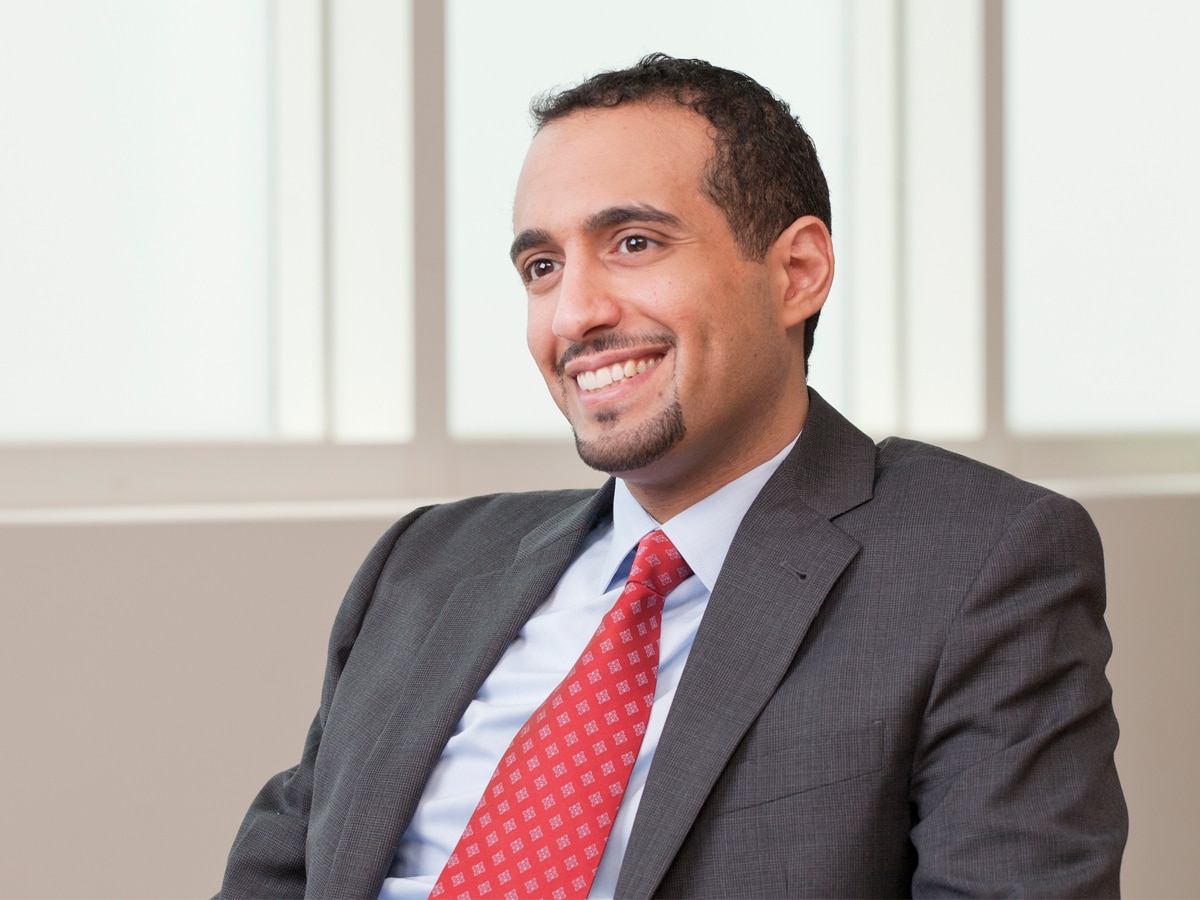

Few capital markets lawyers can lay claim to having advised on nearly every initial public offering (IPO) in the Kingdom of Saudi Arabia since 2011. Except Salman Al-Sudairi. The Latham & Watkins lawyer is the go-to advisor for nearly every major IPO in the past decade, including Saudi Aramco’s blockbuster 2019 listing and recent share sale.
In fact, when we meet, his team has just wrapped up the IPO of Almoosa Health Company—the first in the Kingdom this year. It is the latest in a line-up of recent listings the firm held a leading position, including most recently Rasan, Miahona, and MBC Group.
“There is huge demand for legal talent in Saudi Arabia, and it is an attractive place to establish a long-term career,” Al-Sudairi tells me when we speak.
“Many of the projects that we work on are new and novel,” he adds. “This makes it an incredibly interesting place for someone who is enthusiastic, can think on their feet, and who wants to be a part of shaping a modern economy.”
Journey to the law
Al-Sudairi was brought up in Saudi Arabia, later moving at the age of 12 to the United States where he completed his education. His initial plan was to become an investment banker, but he decided on a career in law after enrolling at Villanova University’s Charles Widger School of Law. He graduated with a Juris Doctor (JD) in 2000 at a time when the dot-com bubble burst and the New York stock market crashed leading him further towards a career in law with a focus on capital markets.
He began training in the Riyadh office of a global law firm in 2003, the same year the Saudi Arabia Capital Markets Law and Capital Market Authority (CMA) was established, and so he has observed the evolution of the Saudi Arabia stock market from the outset. He describes the market back then as ‘over the counter’, meaning transactions would take place outside the stock exchange in other parts of the world. Now, in the more than 20 years he has practised law, the US and Saudi Arabia-qualified lawyer says the stock market has advanced significantly and we are seeing large-scale listings many of which are marketed internationally and on par with the standard of listings in the UK, the US, and elsewhere.
“I have been very fortunate to see the market evolve from day one, and to work on early transactions where we were shaping the market. This has been a wonderful thing to be a part of,” he reflects.
The stock market has been through various cycles in the years since which have proved useful for its development. “There have been many learnings along the way, all of which have helped us reach our current position and deliver work at the highest level,” he adds.
Al-Sudairi is bullish for the year ahead. “The IPO pipeline is bigger than we have ever seen it,” he says. “There is growing interest from both issuers and the demand side—and I do not see this slowing down any time soon.”
He anticipates more technology start-ups will look to go public, either on Tadawul, the main market, or Nomu, the secondary market. He also points to sovereign offerings as a trend which he thinks will continue. Saudi Arabia’s Public Investment Fund (PIF), for example, has a large portfolio and recently taken a number of companies public.
Building a legacy
Al-Sudairi joined Latham & Watkins as an associate in 2007. “What stood out to me when I joined the firm was the lack of hierarchy,” he says. “I was given responsibility for projects and access to senior partners from very early on, and this is how we continue to conduct ourselves.”
Initially based in the firm’s New York office, he returned to Riyadh in 2010 as a senior associate to help set up the firm’s Middle East operations. He was promoted to partner in 2012 and tells me he has been sitting at the very same desk since.
“The market around us continues to change, but our culture here at Latham & Watkins—the DNA of the firm—holds strong,” he says. “We are driven, innovative, and work as a team. This is the key to our success.”
“Our people are our biggest asset,” he adds. “We are committed to investing in them and helping them to achieve their full potential.”
Al-Sudairi has advised on numerous listings over the years and recounts what it was like to be involved on the inside of the world’s largest to date, representing the banks on Saudi Aramco’s $25.6 billion IPO.
“As a Saudi national, it was a source of pride,” he says. “This is the marquee asset of the Kingdom—the national oil company. To be involved in that transaction at that level, which is by far the most significant this market has seen, was something that I am extremely proud of. It was a great opportunity, for me, personally, and for us as a firm, to play a role. It was a real privilege.”
The Saudi momentum
Saudi Arabia has traditionally seen a substantial amount of foreign investment flow into the Kingdom, particularly in industrial sectors such as oil and gas. As the country looks to continue its growth trajectory, elevate the economy, and meet the aspirations of Vision 2030, Al-Sudairi explains the market will require significantly more foreign investment. To this end, Saudi Arabia is introducing a new Investment Law, due to come into force in February 2025.
“Saudi Arabia is undergoing a huge transformation, and we need more capital. We need foreign investors. We need the world to participate. So, everything the government is doing from a regulatory standpoint, with the new Investment Law, but also with other regulatory reforms, is to make sure we have as transparent a system as possible—one that is conducive to international investors coming into the country and having their rights protected. That is really the aim of the new law—it is to give that additional comfort, and to move in the direction that we need to move as a country,” he says.
As multinationals such as private equity houses look to the Middle East and the region’s biggest economy in Saudi Arabia, Al-Sudairi considers this an interesting prospect for the firm. “We regularly work with multinational organisations to help them in their Middle East transactions,” he says. “Our global network means we are well-positioned to deliver fully integrated services.”
A raft of international law firms have entered Saudi Arabia in recent years, with some establishing their regional headquarters in Riyadh. Magic Circle firms A&O Shearman, AS&H Clifford Chance, Freshfields, and Linklaters have a deep presence in the Saudi Arabia legal market. US-headquartered firms Baker McKenzie and White & Case are similarly established in the market, while new entrants such as Gibson Dunn and Kirkland & Ellis are beginning to be seen on a greater number of transactions.
“Competition is healthy,” he says. “We welcome new entrants to the market, but there is no complacency from us despite our track-record. We are focused, ambitious, and we have great momentum in the market.”
For international law firms looking to enter the market, Al-Sudairi has advice on how they can ensure sustainable growth. “Establishing a meaningful presence in the Saudi market—or any market—is a long-term investment,” he says. “Some new entrants do it better than others, but the expectation that a firm will open its doors and make immediate and significant gains is unrealistic. It takes a clear vision, hard work, and commitment to build a meaningful presence.”
In Riyadh, Al-Sudairi, along with a number of partners, took over existing operations under The Law Office of Mohammed Al-Sheikh which became The Law Office of Salman Al-Sudairi in affiliation with Latham & Watkins. It became known as Latham & Watkins after Saudi Arabia reformed its rules to allow foreign law firms to operate independently in the Kingdom.
New entrants must grapple with the government’s Saudization scheme requiring around 70% of their workforce to be Saudi nationals. “There are only so many Saudi lawyers currently in the market, so making sure that you have a plan to develop your own talent is very important to ensuring sustainable growth,” he says.
Al-Sudairi, who spearheads the firm’s regional practice, also encourages international firms to ensure they have an integrated practice from a regional, but also global, standpoint.
Latham & Watkins has a long history and legacy in the US. It is the world’s second biggest law firm by revenue with over 3,500 lawyers across 29 offices. In the Middle East, there are 17 partners and 77 local and internationally qualified attorneys across two offices in Dubai and Riyadh, with the latter made up of nearly 50 lawyers (mainly Saudi nationals).
“The Middle East is an important part of our global practice,” he says. “We are always going to be thoughtful about when and where we grow, and look for the very best talent in the market that will positively contribute to our long-term growth, success, and culture.”
“The main thing that I have learned about the region is you need to be dynamic, you need to move quickly, and you need to pursue opportunities as they come.”
Training the next generation
Al-Sudairi is incredibly passionate about training the next generation of lawyers in Saudi Arabia and the wider Middle East. “It is incumbent on us as law firms to train lawyers, not just because we have to, but because we need to in order to meet future demand,” he says.
“We have invested heavily in our training programme,” he continues. If you look at most of our associates, they came to us straight out of university or, in many cases, were in university as student trainees and continued on with us. Two of our most recent partners, Najla Al-Gadi and Abdullah Alsaeed, started with us as trainees and came up through the ranks.”
His advice to those interested in a career in high-stakes transactional work is to prioritise a long-term outlook over short-term gains. He encourages they look beyond their formative years and consider what is best for them in the years ahead and which firm will help them get to their ultimate goal.
“My biggest piece of advice to aspiring lawyers would be to be patient. You need to focus on your long-term goals, and not get distracted by short-term wins,” he says. “It is very hard to jump levels in the practice of law. So, find the right mentors and a firm that will help you to achieve your biggest ambitions.”
This article was first published in the February 2025 inaugural print issue of Law Middle East.