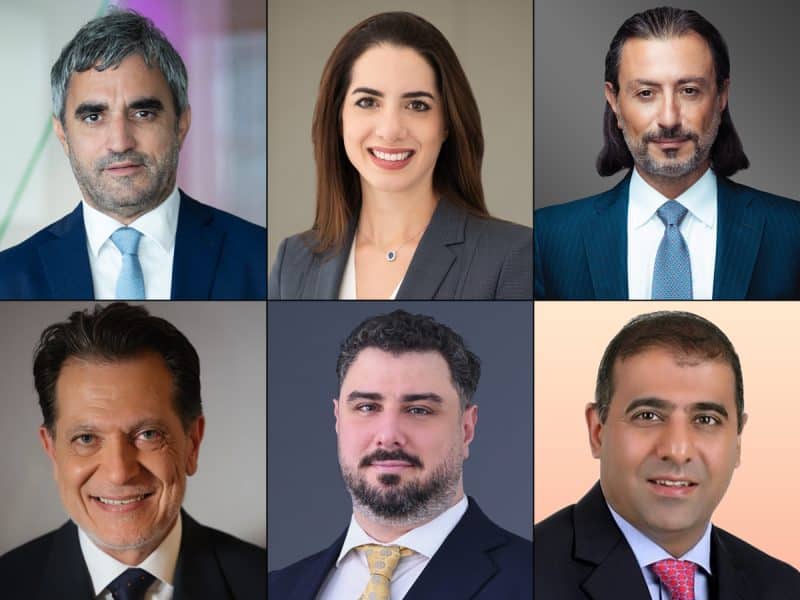

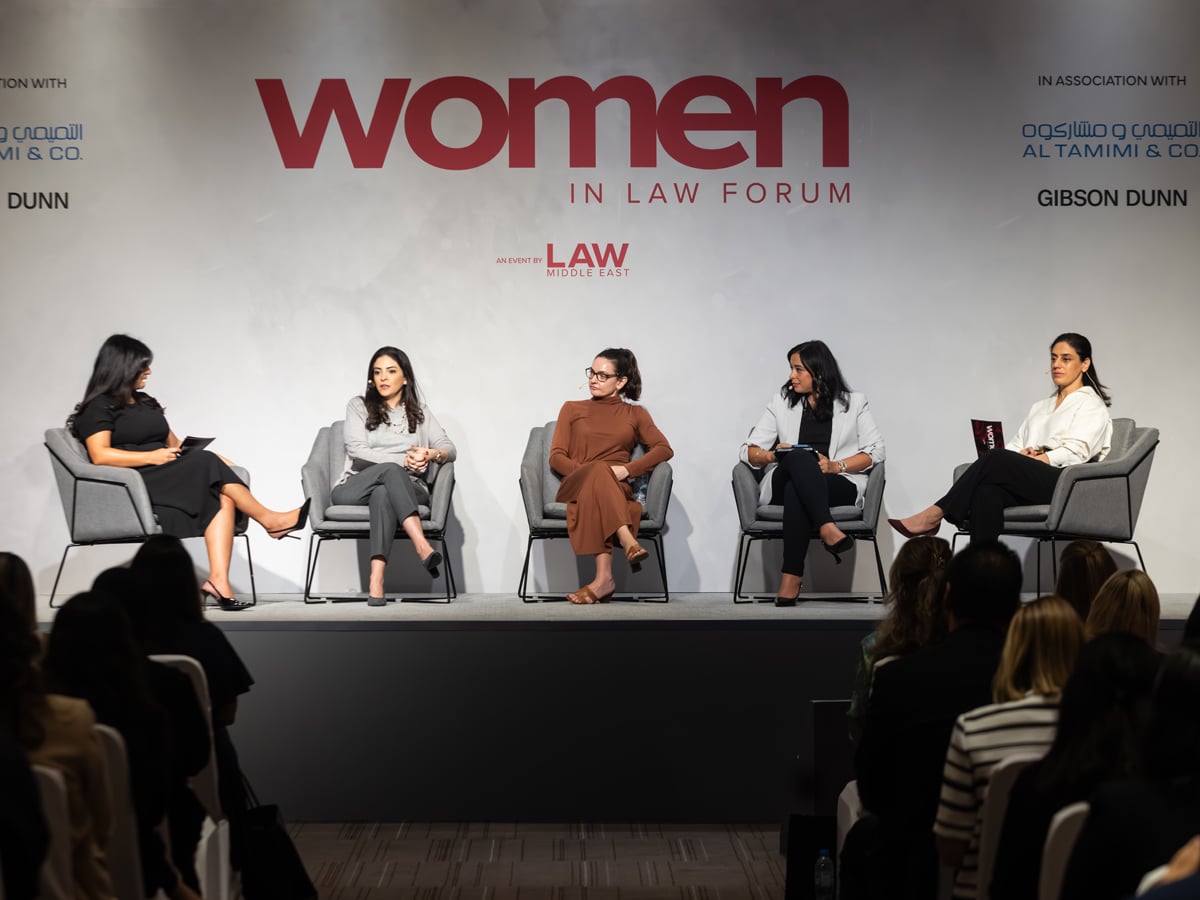
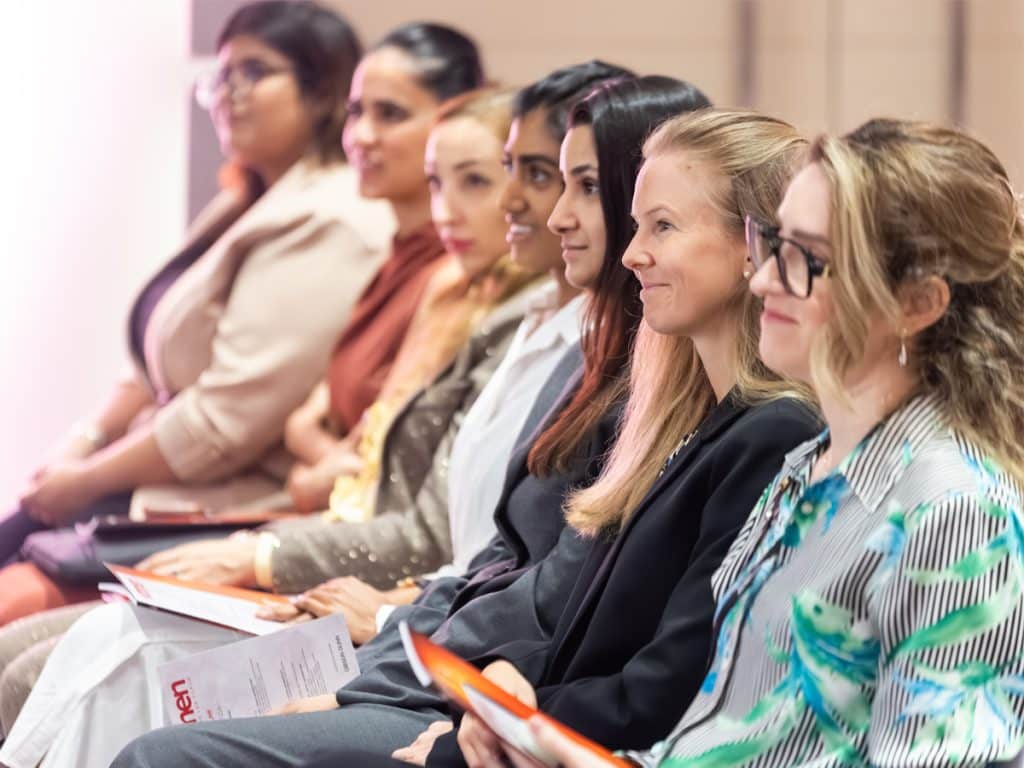
At the inaugural Women in Law Forum, a roomful of legal professionals gathered to hear hard-earned insights from four top female partners in private practice. Drawn from Clifford Chance, Linklaters, Baker McKenzie, and Gibson Dunn, the panel brought together decades of global experience and regional expertise under a single theme: Life in private practice.
The discussion offered an unusually candid look into the making of a partner at an international law firm in the Middle East, including what it takes, why the region is a distinctive proving ground for legal talent, and how these women are challenging traditional norms of leadership along the way.
The speakers
• Clifford Chance corporate partner Lynn Ammar
• Linklaters partner and Middle East construction head Sarah Hudson
• Baker McKenzie dispute resolution partner Sally Kotb
• Gibson Dunn banking and project finance partner Laleh Shahabi
Moderator: Law Middle East editor Aishah Hussain
The path to partnership
Everyone on the panel had made partner, but none had taken the same route. For Lynn Ammar, corporate partner at Clifford Chance, it was a goal she had set her sights on from the beginning. “I started off in big law right after graduating from Harvard Law School,” she told the audience of over 150 delegates. “At the time, I had no exposure to international experience … so getting to understand how the system works was very challenging at the beginning.” But early mentorship changed her outlook. “Partners are made in years one to three,” she recalled being told. “Unlike what people in the industry typically think… if you want to pursue it, you should focus on it from year one.” That early focus shaped her entire trajectory. “Each stage of the career exposes you to new challenges,” she said. “You are generally in your late 20s, early 30s… so you are also thinking about family and other personal considerations. It can definitely be a period of high stress, but having the right support system around you and people who can continue to push you forward is instrumental.”
“Partners are made in years one to three. If you want to pursue it, you should focus on it from year one.”
—Lynn Ammar, Clifford Chance

For Sarah Hudson, a partner at Linklaters, the journey was less direct. She started her legal training in London with the ambition of becoming a family lawyer, until reality set in. “I thought I wanted to be a divorce lawyer,” she admitted. “It turned out that I actually wanted to be a construction lawyer.” That pivot early in her career set the tone for what came next. “The big takeaway message that I would try and give to everyone here is to really think about relationships,” she said. “Be honest with yourself about the things you enjoy, the things that bore you. That is how I found the path for myself.”
For Sally Kotb, a disputes partner at Baker McKenzie, the road ran straight through the region. She began her career in Cairo before moving to Dubai in 2012. “Transitioning into partner did not really come overnight,” she said. “It required a lot of hard work, determination, consistency… and building a name not only with clients but within Baker McKenzie’s own network.” Her advice echoed the others: talent is only one part of the story. “One factor that helped me throughout the way, especially given the tension of life, was having a great team behind me,” she said. “Someone to support me, someone I could go back to and bounce ideas off.”
“It required a lot of hard work, determination, consistency… and building a name not only with clients but within Baker McKenzie’s own network.”
—Sally Kotb, Baker McKenzie
For Laleh Shahabi, a banking and project finance partner at Gibson Dunn, career progression came not from rigid goal-setting, but from trusting in her ability and staying open to risk. “It was not necessarily mapped out… just a combination of things, making sure you hone your craft and are good at what you do,” she said. “Being in a position where you are not only a trusted pair of hands to do the work, but also someone people can bounce ideas off… That is essential.”
Still, one thing she emphasised: do not keep your ambitions a secret. “Being honest with yourself about what that ambition is, and being able to articulate it to those in decision-making roles, is very important.”
Lessons from the top
For many lawyers, making partner is seen as the finish line. But for the women on this panel, the promotion marked a beginning of a new mindset, a different kind of workload, and a fundamental change in how they defined their role.
“I have been focusing on business strategy as well as day-to-day client work,” said Hudson, who was promoted to partner in May 2025. “The hardest thing for me has been understanding what the new expectations are.” Like many high-performing lawyers, she defaulted to taking on too much. “I very much still held on to the, ‘Do not shirk your work. You are responsible for this deal’,” she said. “But actually, it is not me, it is my team. I was not listening to my team saying, ‘Sarah, I can do this’.”
The lesson? Leadership is not about doing it all—it is about letting go when it counts. “If I did not have senior people to talk to, particularly other senior women, I would have just run myself into the ground,” she told the audience of women and men.
For Shahabi, becoming partner required not only delegation but a complete reframing of professional value. “It is not a destination; it is a mindset,” she said. “It is about how you create value. It is very different than what you were doing as a senior associate.” She described it as a transition from “delivery” to “influence”, saying; “You are not just executing legal work anymore. It is about building the team, growing the business, influencing the strategy.” That shift is not something most associates are trained for, she added—but it is exactly what the role demands.
“It is not a destination; it is a mindset. It is about building the team, growing the business, influencing the strategy.”
—Laleh Shahabi, Gibson Dunn
The Middle East difference
For women who trained, qualified, and worked in major financial centres like London or Paris, the UAE offered something different: space to lead, and fewer structural barriers to client development. “In London… relationships and client networks felt concentrated in people who had that kind of background. I did not,” said Hudson. “When I came to the Middle East, I realised I could build strong client relationships based on my work and who I am as a person.”
That access, to clients, to leadership, to opportunity, was a recurring theme. “We are at the frontier of deal making,” said Shahabi. “We do some of the first-of-its-kind transactions here… but we are also dealing with, at the same time, an evolving legal landscape.” That evolution creates both complexity and leverage. “That means we can become trusted advisors, not just legal counsel, but part of the team,” she added.
But regional practice also demands deep regulatory fluency, something many lawyers do not fully grasp until they are in the system. “Here, there is always a UAE element to the deal,” said Ammar. “You are dealing with federal law, the laws of each emirate, and 46 free zones. It is very challenging.” That legal fragmentation makes having strong local knowledge critical, even in international firms. And it reinforces one of the key differences in how lawyers are expected to operate. “In other jurisdictions, you are expected to specialise,” she said. “In the UAE, you have to combine the best of both worlds: be a generalist and a specialist.”
Defining moments
Deals and disputes may come and go, but a few stay with you, either because they were high profile, personally validating, or simply impossible to forget. For these partners, certain matters stood out as turning points.
For Kotb, it was a technically thorny arbitration involving questions of capacity and agency—where the legal issue itself pushed the boundaries of UAE jurisprudence. “The client signed an arbitration agreement in relation to the project with an agent, but the main dispute was with the parent company that did not sign the agreement,” she explained. The legal strategy focused on whether the parent company could be bound by an agreement it had not signed, based on a principle-agent relationship. “In the UAE, arbitration is considered an exceptional means of dispute resolution,” Kotb said. “So, extending arbitration to a third party was very challenging.” After deep research, she discovered a rare Court of Cassation ruling that supported their position. “The tribunal adopted our analysis in the award,” she said. “It was a really proud moment for me. It proves that things can be hard, but give it your all and you never know how it will turn out.”
Shahabi reflected on deals where the legal work had a real-world, developmental impact. “I worked on a series of solar power plants in Jordan,” she said. “Jordan was facing an acute energy security issue… this had a significant impact.”
At Clifford Chance, Ammar described her headline-making advisory role for Disney on its first-ever Middle East theme park in Abu Dhabi. “It is the first Disney theme park resort in the region. It had strategic importance for both Disney and Abu Dhabi,” she said. “It was also the first major deal I led after joining Clifford Chance, so it was a milestone on multiple fronts.”
Where the legal industry is headed
When the conversation turned to industry-wide shifts, the panel offered a front-row view of how regional and global trends are reshaping legal practice in the Middle East, from capital flows to client expectations.
In banking and project finance, sovereign wealth funds and giga-projects continue to dominate the capital landscape. “We are seeing private capital, private equity, infrastructure funds, all entering the market,” said Shahabi. “That is newer here than in Europe or the US.” It is not just Abu Dhabi and Saudi Arabia-backed government entities driving the deals anymore, private capital is starting to reshape what gets financed and how. “Debt becomes the tool and enabler in making giga-projects viable and scalable,” she added.
On the disputes side, Kotb said arbitration in the Middle East has fully matured. “The UAE has proven itself as an international arbitration hub,” she said, pointing to the rise of DIAC, arbitrateAD, and the SCCA. “They are really competing with global seats like Paris, London, and Singapore.” She also highlighted the rise in mediation, particularly in the aftermath of the Covid-19 pandemic. “Clients are more strategic now. They want options. They want things to be resolved cost-effectively, and that is driving a push for alternative fee arrangements.” Greener processes are also trending. “Virtual hearings, digital bundles—that is here to stay.”
In construction, Hudson said old risk-allocation models are no longer fit for purpose in the age of mega-developments. “Gone are the days when you just push all the risk onto the contractor,” she said. “Construction lawyers need depth. You cannot structure a project if you only know the old models.” The new reality demands more than legal drafting, it requires risk strategy, contract engineering, and dispute prevention. “You have to be able to think about where disputes will arise, and stop them before they do,” she said.
Across corporate and M&A, Ammar pointed to two defining drivers: geopolitical hedging and investor diversification. “The first half of the year has seen a flurry of deals,” she said, noting record foreign direct investment (FDI) and outbound activity from regional sovereigns. “The UAE, Saudi Arabia, and Qatar have made financial commitments into the US that exceed $1.5 trillion over the next ten years,” she said. “This region is no longer just where capital is raised. Now global funds are under pressure to deploy here.” Ammar also addressed the emerging role of artificial intelligence (AI) in reshaping firm operations. “AI will not replace lawyers but it will make law firms look very different,” she said. “The size of firms will shrink, especially at the junior level. And pricing models will shift away from hourly rates.”
What they wish they knew sooner
After over an hour of detailed discussion, the panel closed with the practical advice they wished someone had given them earlier in their careers. The answers were candid, and telling.
Shahabi said: “Be present in whatever it is you are doing, at home or at work. And do not take things personally. It is often not about you.”
Kotb added: “Work with passion. Give it your all. But do not rush. I made sure to give everything at the lower levels to make sure I could keep up when I made partner.” She also urged junior lawyers to embrace change: “This is a learning profession, keep up with developments. AI is here to stay.”
Hudson offered a dual mantra: “Push yourself, but do not punish yourself.” She carves out non-negotiable time to ride horses. “Respect your free time. Keep yourself happy—you cannot stay passionate about your work otherwise.”
“Push yourself, but do not punish yourself. Respect your free time, you cannot stay passionate about your work otherwise.”
—Sarah Hudson, Linklaters
And finally, Ammar closed with something she first heard while studying for the New York bar: “It is a marathon, not a sprint,” she said. “You need discipline, resilience… and you cannot let a single instance demotivate you or sway you from your path.”
The inaugural Women in Law Forum 2025 was hosted by Law Middle East and headline sponsored by Al Tamimi & Company with support from partner Gibson Dunn. It took place on the morning of Tuesday June 24, 2025 in the Origami Ballroom at VOCO Dubai by IHG. Register for upcoming Law Middle East events.
This article was first published in the July-August 2025 print issue of Law Middle East.