

After 16 years in senior leadership positions, including eight years as CEO of Eversheds Sutherland (International) in London, Lee Ranson has made his next move, transitioning to a non-executive partner role in Dubai. The move aligns with his personal interests and professional ambitions, bringing him closer to the burgeoning opportunities across the Middle East and beyond.
A region of dynamism and opportunity
“It always intrigued me that I was leading a global firm, but I had always lived in London,” he tells me when we meet on the first day of his new role. “Dubai offers a new opportunity which is exciting.”
He goes on to explain that he was drawn to the “energy and dynamism” of the Middle East, describing it as a “nascent and entrepreneurial” environment. He sees Dubai as a “melting pot of cultures and opportunity”, offering a fresh perspective from traditional “old-world centres”.

Changing global dynamics
Ranson’s tenure as CEO was marked by the pursuit of global expansion. “When I first became chief executive, I remember thinking to myself, the business has to become more global, and our people have to be engaged on more global mandates,” he recalls. Ranson subsequently led the firm through a successful transatlantic merger in 2017 and then, in 2023, during his second term, he led the firm to enter an exclusive arrangement with King & Wood Mallesons in China. His new role is designed to ensure this momentum continues, leveraging his deep knowledge and experience.
Ranson’s new role is fully integrated with the firm’s global strategy. Keith Froud, the new CEO of the international business and Ranson’s former managing partner, is “very keen that I continue to drive strategy here and the growth opportunities moving forward”, says Ranson, referencing the firm’s refreshed strategy launched in June 2025. The overarching aim is “to be able to service our clients across the globe in the key markets in which they operate”, he adds.
Ranson points to changing global dynamics which make the Middle East and adjacent markets even more crucial. “There are changing patterns taking place in the world right now, so that, for me, means that it is even more important that we are able to present to our clients a very credible offering in the Middle East and Asia, because they are looking for new markets, and if there are restrictions about how they can potentially trade in some of those existing markets, particularly in the US, they will seek out other opportunities,” he says. Ranson believes the UAE and Saudi Arabia “have a role to play in those markets”, referencing their ability to attract investment given the “level of stability, ease of doing business, and sensible regulation”.

Strategic alignment and future growth
Eversheds Sutherland has seven regional offices and his move to Dubai was strategic given its ideal geographic position, says Ranson. His role will focus on strengthening connections to the Middle East, especially with nearby Asia—from China to India and beyond—as the continent increasingly forms a corridor of trade and investment with the region. He believes more senior leaders at global law firms will relocate to the Middle East, in recognition of its emerging role as a “centre point for the East and West”, adding his own presence in the region enables him to capitalise on opportunities and identify areas for investment.
Eversheds Sutherland has a long-standing presence in the region, with close to 30 partners across seven offices in Abu Dhabi, Amman, Baghdad, Doha, Dubai, Erbil, and Riyadh. The firm entered the region nearly two decades ago and has since grown through strategic alliances, including a joint venture with a local practice in Saudi Arabia. Ranson emphasises the global firm’s local tie-ups are not simply outposts, but deeply connected to the region and fully integrated with the wider firm. He believes this approach will be crucial moving forward as it “brings global standards of delivery to legal services, combined with local knowledge”.
The region’s legal and business environment has a reputation for efficiency and stability, notes Ranson. He has been particularly “heartened to see there is significant interest from the US and Europe”. It has a reputation for “getting things done”, he adds, referencing the encouragement from authorities to execute projects, coupled with innovation and hefty investment.

“In the time that I have been in management I have seen the region evolve and increasingly mature,” he continues. “What we were potentially looking to create ten to 15 years ago is now very different from what the reality of the opportunity is,” he observes. “The focus has expanded beyond, say, real estate and mergers and acquisitions (M&A) into banking, finance, construction, international arbitration and more, signifying a much bigger play.”
While the firm has a substantial regional office network, Ranson acknowledges the potential for further expansion in certain jurisdictions. The prospect of further tie-ups in the Middle East and wider region is not off the table. He emphasises the firm, including its new executive team, is “very alive to opportunities”, which encompass hiring new teams, forming strategic tie-ups with suitable firms, and entering new areas and markets.
Lessons from leadership and future challenges
Key lessons from his time in management that Ranson plans to bring to his new role include the ability to push strategy forward and drive growth in priority areas, while maintaining agility in the face of unexpected challenges. He recalls navigating the global financial crisis as managing partner and Covid-19 as CEO, and says there will inevitably be movement in the Middle East as it is a fairly nascent region, but the key to navigating this is to remain agile.
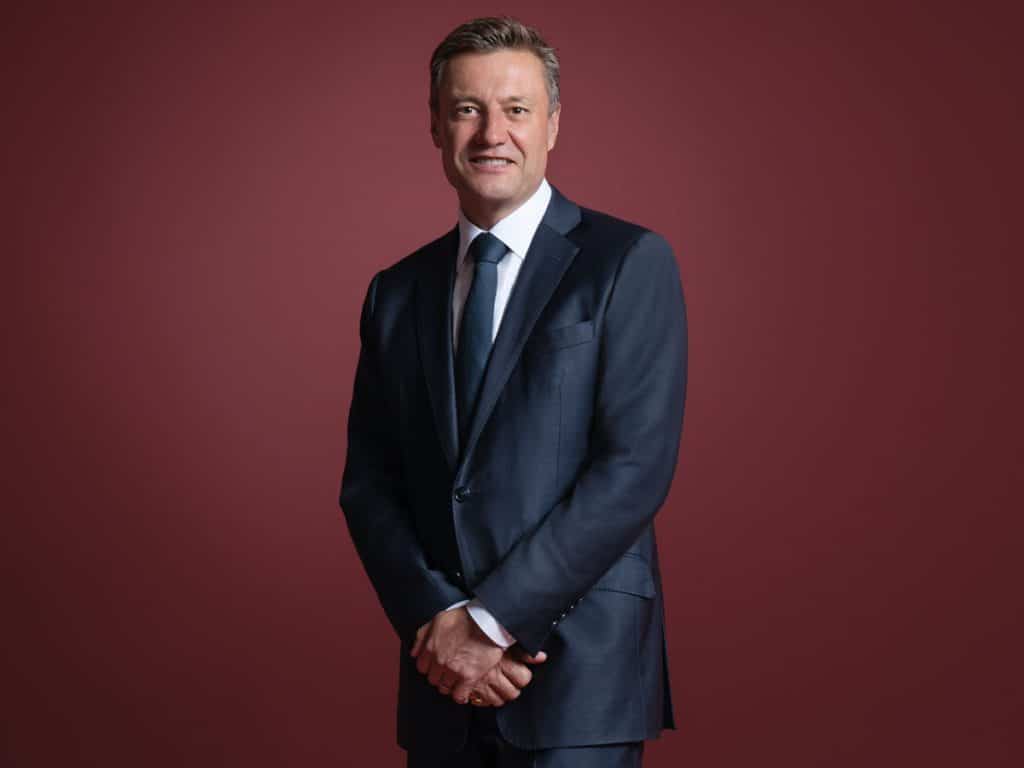
His core leadership principles revolve around leaving the firm in a stronger position, extracting the best out of people by recognising their strengths and the opportunities they can be given, while ensuring they have a clear sense of the firm’s strategy and its direction. To this end, he tells me he would employ the “corridor test”—if a passing colleague in a corridor could not articulate the firm’s strategy, it was his, not their, fault. He also firmly believes that leaders should be actively involved and lead from the front. As he puts it, “there is nothing worse than the idea that orders are coming from the centre”.
His track record speaks to this, having increased firm revenue by close to 60% during his time in management. He attributes this to his “clarity of destination” and aligning the firm’s focus with client needs and market demand. “We talked openly about growth: how we as a law firm make sure that we are in the right markets to best service our clients, and how we distil that message in a way that clients understand,” he says.
Career trajectory and advice
Ranson, a commercial litigator by training, highlights his varied career within Eversheds Sutherland, from finance litigation to real estate, and ultimately to management. He credits the firm’s continuous evolution—from a collection of UK firms to a global entity—for keeping him engaged throughout his entire professional career. “It feels like I have been in ten different firms,” he says, underscoring the constant challenge and growth opportunities it provided.

Prior to his legal career, Ranson spent just under two years in the Avon and Somerset police force, a role he “absolutely loved” and which he credits with preparing him for resolving conflict as a lawyer. After qualifying in 1990 during a mini-recession, he gravitated towards litigation due to the scarcity of transactional work and his enjoyment of the field. However, as his career progressed, he transitioned more into transactional work, particularly mergers and strategic acquisitions, which ultimately accounted for at least half of his career. He specialised in real estate matters, eventually becoming the head of the firm’s real estate practice. He continued fee-earning until midway through his first term as managing partner, at which point he shifted focus to client relationship management.
For aspiring lawyers and those considering relocation to the Middle East, Ranson, who graduated with a law degree from the University of Hull, offers encouragement. He sees the region offering a “slightly rawer experience”, which for him, and for many, is exciting. He advises that individuals with an “entrepreneurial, go getter, energetic approach” and who are “self-motivated” will thrive in this environment. He also recommends undertaking a secondment to the region during training to gain exposure and experience and thinking strategically about qualification and the area they ultimately decide to specialise in.
As Ranson embarks on his new move in Dubai, his focus remains on galvanising Eversheds Sutherland’s growth and capabilities across the Middle East and Asia.
“I want people here to be excited by the opportunity in the region, but also be excited by the connection to the global markets,” he says.

This article was first published in the July-August 2025 print issue of Law Middle East.